Cloud telephony
Cloud telephony for call centers, on your own carrier.
- Any
- SIP carrier, with your own numbers
- 30 s
- between trunk health checks
- 0
- desk phones or EPABX boxes
- 60
- agents at FC BPO Services
By the Dialtrix team · Updated
What is cloud telephony?
Cloud telephony is a phone system that runs on a provider's servers instead of an EPABX in your office. Calls travel over the internet, agents call from a browser or an app, and routing, recording and reports are software settings, not hardware. Adding a seat takes minutes. No technician.
Cloud telephony and VoIP get used as if they mean the same thing. They don't, quite: VoIP is how the voice travels, as data. Cloud telephony is the whole phone system, built on VoIP and delivered from the cloud.
How cloud telephony works on Dialtrix
Four parts, from the carrier to the headset. You choose the first one. Dialtrix runs the rest.
01Your carrier
A licensed telecom provider issues your numbers, including 140 and 1600 series, carries the calls and bills you for minutes at its rates.02A SIP trunk
Connects the carrier to Dialtrix by registration, credentials per call or IP authentication, over UDP, TCP or TLS, with the codecs you choose and order.03Dialtrix
Routes inbound calls, dials outbound in four modes or as AI dial sessions, records, transcribes and reports. Trunk health is checked every 30 seconds.04The agent's browser
Agents sign in and talk over WebRTC on a computer or a phone, with a headset. No desk phones and no EPABX.
Cloud telephony vs EPABX vs a bundled provider
A bundled provider is the easy choice for a small office that wants numbers and a simple phone menu from one vendor, and we'd say so. A call center that dials at volume does better on its own carrier, with the dialer and AI built in.
| On-premise EPABX | Bundled cloud telephony | Dialtrix on your carrier | |
|---|---|---|---|
| Hardware | A box in the server room and a desk phone per seat. | None. | None. Agents use a browser. |
| Numbers and minutes | From your telecom operator. | Bought from the provider, with minutes inside its plan. | From your own carrier, at its rates. |
| Adding 20 agents | Extensions, phones and a technician. | 20 more seats on the plan. | 20 more logins, no charge. |
| Dialer and AI | Separate products, if at all. | Often add-ons. | Four dialing modes and AI voice agents included. |
| Remote agents | Hard. | Yes. | Yes. |
| Best for | Offices with fixed desks and little calling. | Small teams that want numbers and a simple phone menu from one vendor. | Call centers that dial at volume, on a carrier they already have or want. |
Who provides what: your carrier and Dialtrix
Your telecom provider holds the licence, the numbers and the minutes. Dialtrix is the calling platform on top. Most confusion about cloud telephony in India comes from mixing the two up.
| Job | Your telecom provider | Dialtrix |
|---|---|---|
| Telecom licence and numbers | Holds the licence and issues the numbers, including 140 and 1600 series. | Uses the numbers you bring, for calls and caller IDs. |
| Minutes | Bills you directly, at its rates. | No charge per minute. |
| Registration and declarations | Takes your 140-series registration and your declaration of automated calling. | Keeps caller IDs per campaign and logs every attempt with a timestamp. |
| DND | Stops 140-series calls to customers who blocked that sector on the DND registry. | Scrubs your lists against DND preferences before a campaign starts. |
| The calling platform | Not its job. | Routing, four dialing modes, AI voice agents, recording, transcripts and reports. |
| Texting | Your Twilio or Telnyx account sends the texts. | The shared SMS inbox and AI texting, on the numbers you call from. |
A cloud contact center for inbound and outbound
- Service level, missed calls, voicemails and time to answer, against the previous period.
- Ring time, give-up time and voicemail for each number.
- Every call recorded to your rules, with a transcript.
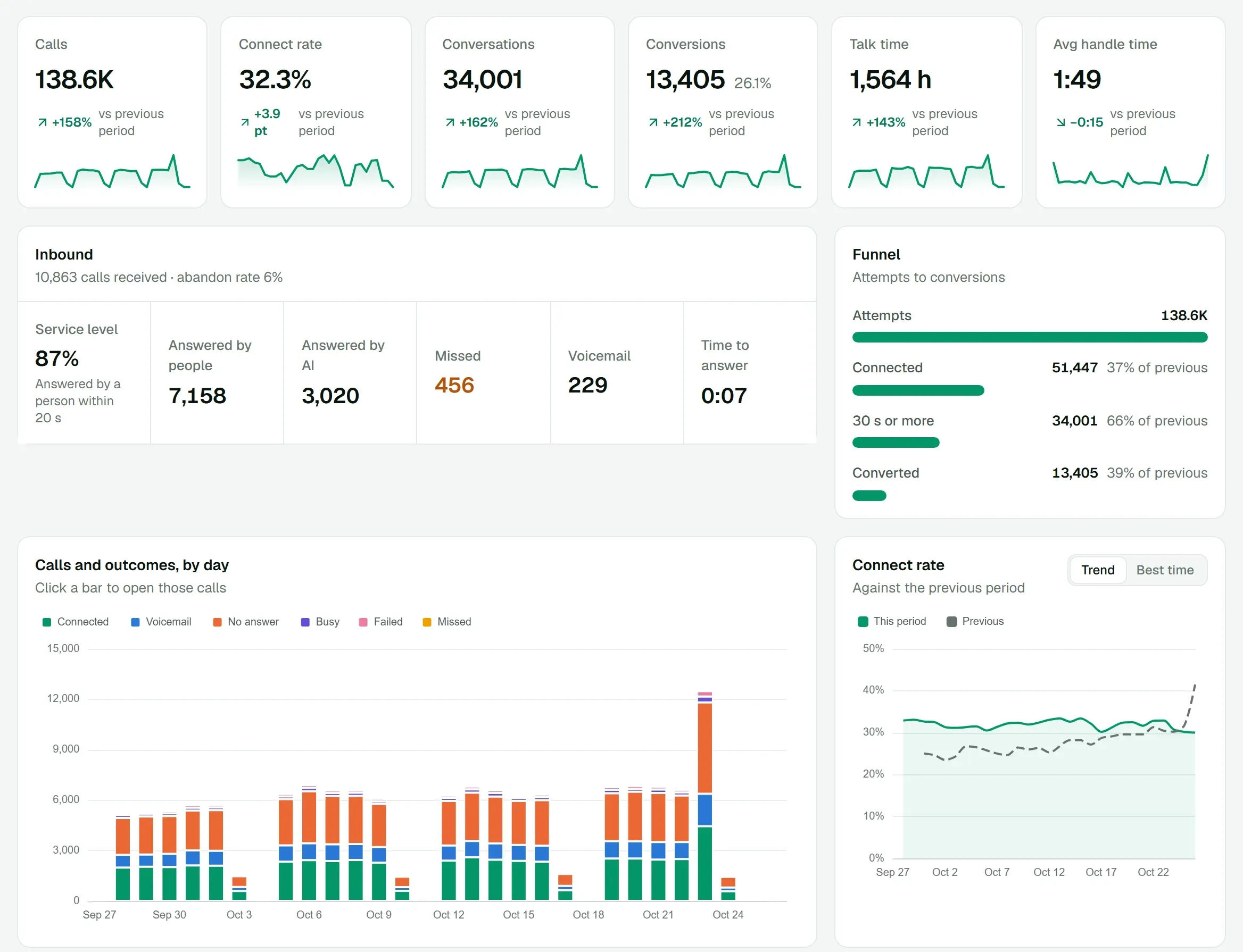
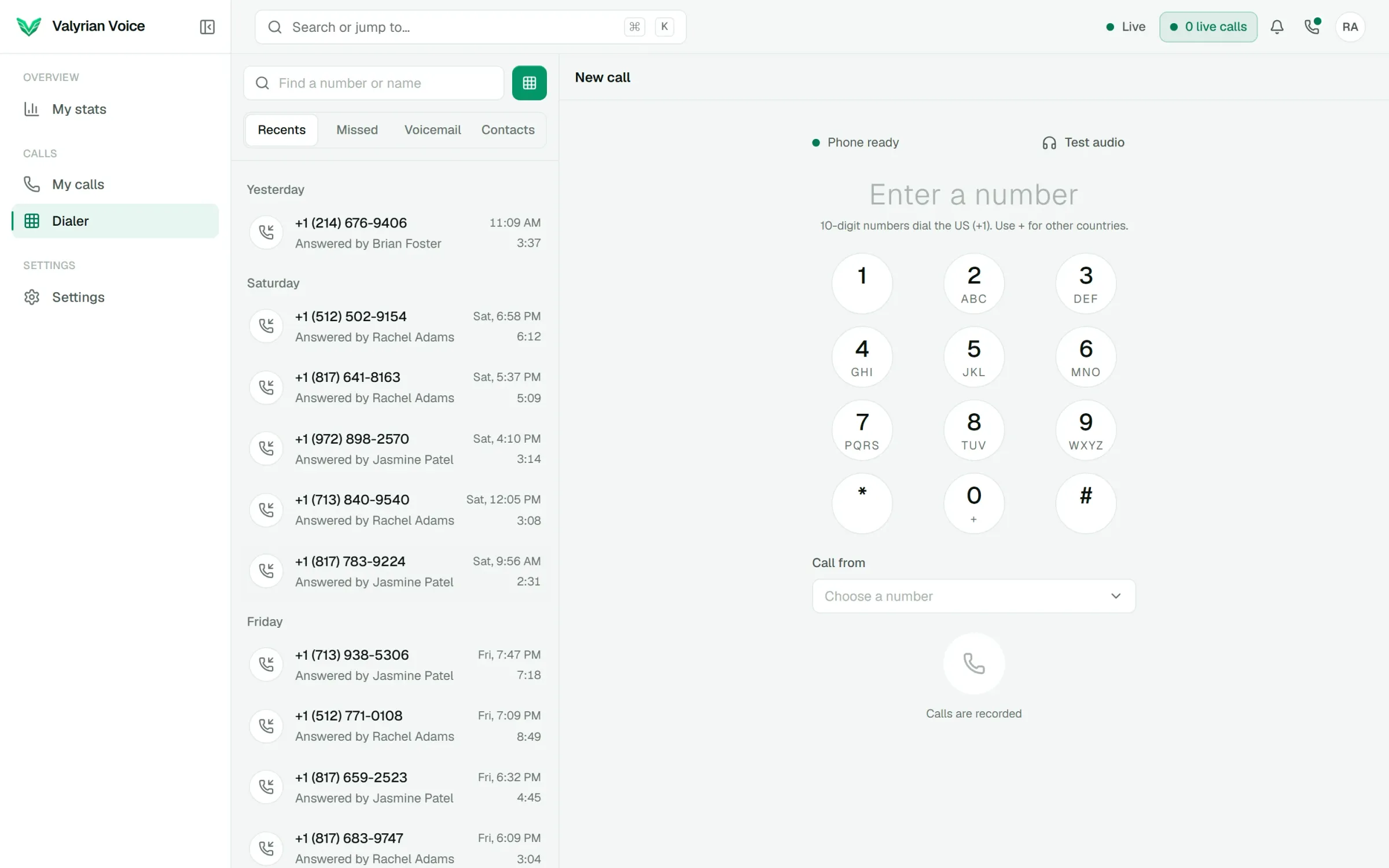
Cloud call center software in the browser
- Blind, three-way and consult transfers.
- One voicemail box per number, shared by everyone on it.
- Recent calls, missed calls and contacts in one panel.
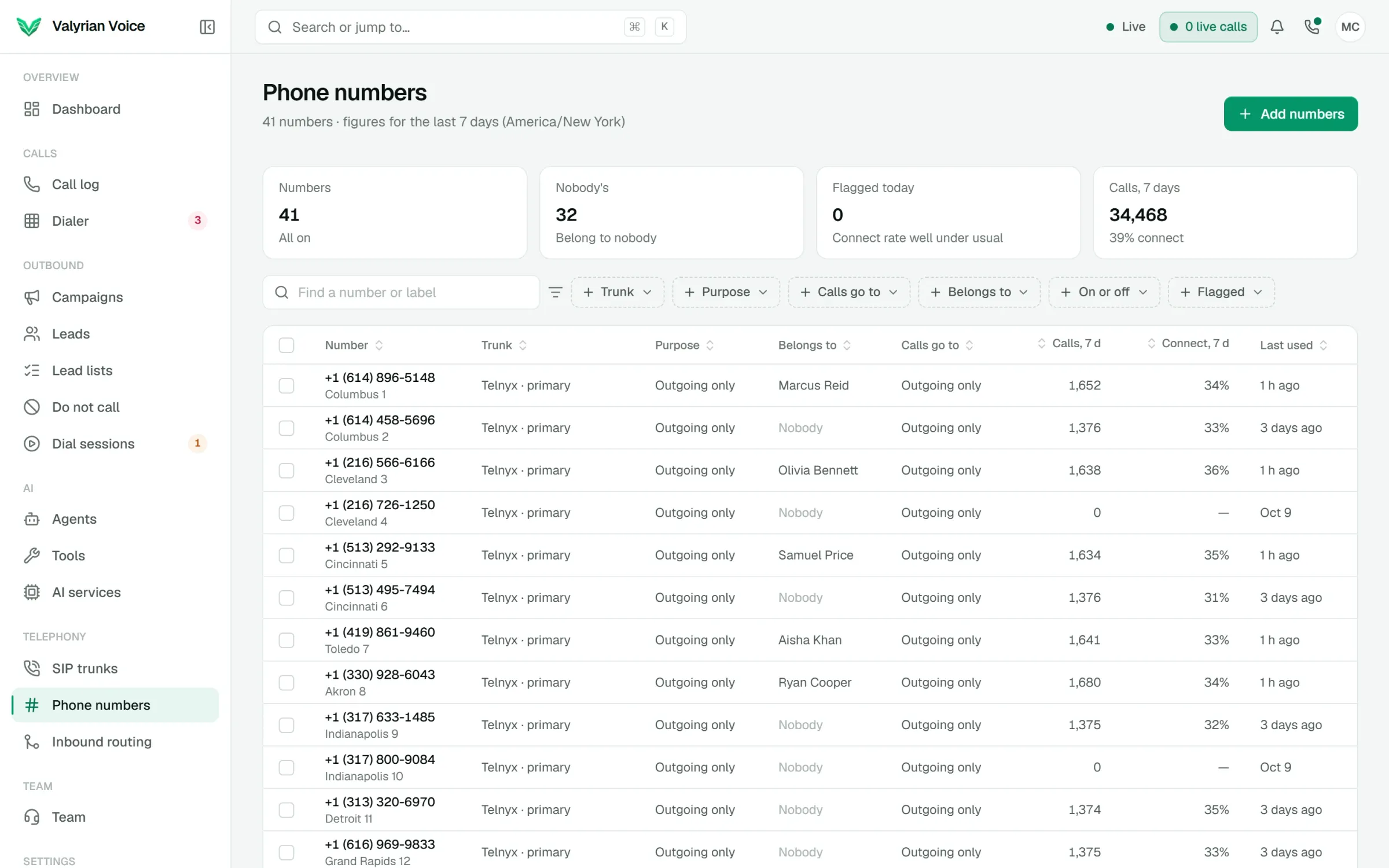
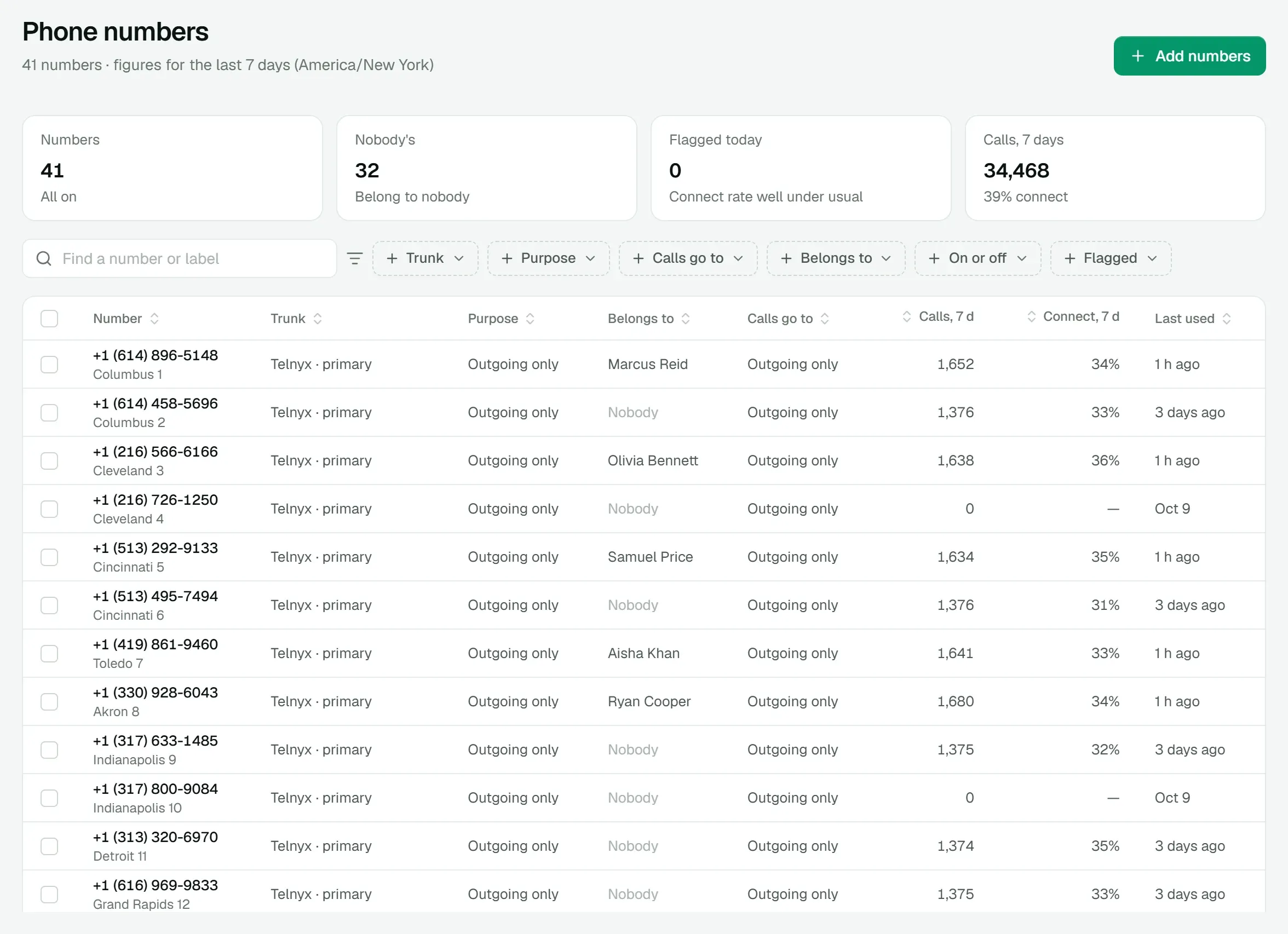
Trunks, numbers and caller IDs, watched for you
- Calls per second set per trunk, and dialing never sends more.
- E.164 with or without +, or national format, per carrier.
- Calls and failures over the last 24 hours, per trunk.
What a call center floor needs for cloud telephony
- A SIP trunk and numbers from your telecom provider.
- A computer or a phone per agent, with a browser and a headset. A USB headset with a noise-cancelling mic is worth the money.
- Bandwidth: roughly 100 kbps each way per simultaneous call on the G.711 codec. A 60-agent floor needs about 6 Mbps each way for voice alone.
- A second internet line for the office, if a dropped connection would stop the floor.
AI calls run between your carrier and the platform, so AI dial sessions don't use your office bandwidth.
Cloud telephony rules in India: TRAI, DLT and telemarketing in 2026
The telecom licence sits with your carrier. What sits with you: registering 140-series numbers for promotional calls through your telecom provider's DLT platform, using 1600-series numbers if your client is a regulated BFSI firm making service calls, and, since TRAI's 2026 amendment, declaring automated calling to your telecom provider.
Dialtrix keeps caller IDs per campaign, scrubs lists against DND and logs every attempt. The full rules, with sources, are in TRAI rules for call center dialers. General information, not legal advice.
How to choose a cloud telephony provider in India
Six questions to ask any provider, Dialtrix included. The first one matters most and gets asked least.
Who owns the numbers
If the provider owns them, leaving means changing every number your customers know. On your own carrier, the numbers stay yours.
Calls per second
Ask what the plan allows. A cap set by a plan tier, not by your carrier, slows a dialer floor at its busiest.
Price shape
Per seat, per minute or flat. For a BPO whose headcount moves every month, the shape matters more than the number.
Dialer and AI
Ask whether predictive dialing and AI voice agents are in the product or sold on top.
Compliance defaults
DND scrubbing, calling hours and per-campaign caller IDs should be on by default, not a project.
Trunk monitoring
You want to know a trunk is down before your agents do. Ask how often it's checked.
Best cloud contact center for a 100-agent outbound BPO in India in 2026
For an outbound BPO of 60 to 100 agents, the best cloud contact center isn't the one with the longest feature list. It's the one where predictive, progressive and power dialing, AI voice agents, a CRM view and call recording come in one price that doesn't count seats, on a carrier you control.
Exotel, Knowlarity, MyOperator, Ozonetel and Tata Tele Business Services are the cloud telephony names most floors in India compare, and Ameyo, Five9 and Genesys Cloud CX are the contact center names larger floors add. Ask each whether numbers, minutes and the platform come as one bundle. Dialtrix is the contact center on your own trunk.
Dialtrix's official features, with what to ask each vendor about pricing, dialing modes and compliance, are on the BPO call center dialer page.
Pricing and features
One flat monthly fee for the platform, with unlimited agents and AI included. No charge per agent or per minute. Your carrier bills minutes and numbers directly, at its rates.
The fee is quoted on your setup.
Cloud telephony features
- Any SIP carrier
- Presets for Telnyx and Twilio, or any generic SIP trunk.
- Three ways to connect
- Registration, credentials per call or IP authentication.
- Transport and codecs
- UDP, TCP or TLS. Choose and order the codecs.
- Calls per second
- Set per trunk. Dialing paces to it.
- Trunk health
- Registration, reachability and round-trip time, every 30 seconds.
- Your numbers
- Direct lines, shared team lines or caller IDs for campaigns.
- Inbound routing
- People first, the AI as backup, voicemail on any number.
- Four dialing modes
- Predictive, progressive, power and preview, set per campaign.
- AI voice agents
- Answer inbound lines and run outbound dial sessions at up to 100 lines.
- Browser calling
- WebRTC on a computer or a phone. Nothing to install.
- Call recording
- With transcripts, AI summaries and a retention period you pick.
- Live analytics
- By campaign, caller ID, carrier, agent and AI agent.
FC BPO Services case study
60 agents, 70% lower costs.
FC BPO Services runs its floor over its own SIP trunk and SMS provider. Moving 60 agents to Dialtrix cut its costs by 70%, and because calls per second now follow its carrier, its rate limits are much higher than on its old dialer.
Read the FC BPO Services case study- 60
- agents on the dialer
- 70%
- lower costs
- Much higher
- rate limits than their old dialer
- What is cloud telephony?
- Cloud telephony is a phone system that runs on a provider's servers instead of an EPABX in your office. Calls travel over the internet, agents call from a browser or an app, and routing, recording and reports are software settings. Dialtrix is cloud telephony for call centers, running on your own SIP carrier.
- Is cloud telephony the same as VoIP?
- No. VoIP is how the voice travels, as data over the internet. Cloud telephony is the whole phone system delivered from the cloud, built on VoIP: numbers, routing, dialing, recording and reports. Every cloud telephony system uses VoIP. Not every VoIP setup is cloud telephony.
- Do I need special hardware for cloud telephony?
- No. Agents need a computer or a phone with a browser, a headset and a steady connection. For a floor, plan roughly 100 kbps each way per simultaneous call on the G.711 codec. A 60-agent floor needs about 6 Mbps each way for voice.
- Do we have to buy numbers from Dialtrix?
- No. You bring the numbers on your own SIP trunk, including 140 and 1600-series numbers your telecom provider issues, and use them for calls and caller IDs. Your carrier bills minutes directly, so carrier rates stay between you and your carrier.
- Which Indian carriers work with Dialtrix?
- Any SIP carrier that connects by registration, credentials per call or IP authentication. Telnyx and Twilio have presets. Tell us which Indian telecom provider you use, and we'll check the trunk with you on a demo before anything moves.
- How much does cloud telephony cost in India?
- Bundled providers charge for seats, minutes and numbers together. With Dialtrix those split: your carrier bills minutes and numbers at its rates, and Dialtrix charges one flat monthly fee for the platform, with unlimited agents and AI included. The fee is quoted on your setup.
- Is cloud telephony secure?
- It can be more controlled than an office EPABX. The trunk to your carrier can run over TLS, agents sign in to the browser dialer, and admins decide who holds which numbers and what gets recorded. Each client's data stays in its own tenant.
- Does a BPO need a licence for cloud telephony?
- The telecom licence sits with your carrier, which issues the numbers and carries the calls. You register 140-series numbers for promotional calls with that carrier and declare automated calling to it. Since DoT's 2020 guidelines, call centers no longer register as Other Service Providers. Check your case with your telecom provider.
- Which cloud telephony providers are there in India?
- Exotel, MyOperator, Knowlarity, Ozonetel, Tata Tele Business Services and Airtel IQ are the names most businesses compare. Ask each one whether numbers, minutes and the platform are sold together or separately. Dialtrix is the platform only, built for call centers, on the carrier you choose.
- Does cloud telephony work for remote agents?
- Yes, that's one of its main uses. A work-from-home agent signs in to the same browser dialer as the office floor. Admins still choose which numbers each agent calls from and what gets recorded.
- Does Dialtrix's cloud telephony include a dialer, CRM and call recording?
- Yes. Predictive, progressive, power and preview dialing, AI voice agents, a CRM view on every call with sync to your own CRM, and call recording with a retention period you choose all run on the same platform, for one flat monthly fee with unlimited agents.
More for BPOs
- BPO call center dialer Predictive, progressive, power and preview dialing for your agents, plus AI dial sessions.
- Auto dialer software What an auto dialer does, the types, and whether autodialing is legal in India.
- Predictive dialer How predictive pacing works, the drop rate, and when not to use it.
- Power dialer Power, progressive and preview dialing, and which one suits your list.
- BPO software Every client in its own tenant, with its own lists, caller IDs and reports.
- Call monitoring Listen, whisper or barge in on live calls, and review recordings by client.
- Facebook Lead Ads dialer Every new Facebook lead goes into a campaign and gets called, by an AI voice agent or a person.
Bring your carrier. We'll bring the floor.
Tell us which telecom provider and how many agents you run. We'll show you the floor running on a SIP trunk and quote one flat fee.